Essay Short-Form Video Formats
Making Versions That Don't Feel Like Reposts
Each platform rewards a different opening, so one song needs three distinct clips.
Making versions of the same song for TikTok, Reels, and Shorts is a creative decision. Each version needs its own visual idea that fits the platform’s culture and attention mechanic. The goal is not to disguise repetition, but to give each audience a reason to watch.
Why posting the same clip across platforms feels like a repost even when it isn't
An artist posts three times and gets nothing back. The clip looks good, the song is strong, and each upload goes to a different platform, yet none takes off. The artist assumes that three platforms are interchangeable containers for one promotional idea. A clip can feel misplaced even to someone who has never seen it before.
TikTok tests a clip on a micro-pool and expands its reach through signals including rewatch and shares. Reels factors in the network graph and story engagement, while Shorts aligns content with topic taxonomy and long-form channel data. A polished promotional clip can therefore read as an ad on TikTok, feel impersonal to followers on Reels, and lack the framing that helps Shorts reach the right audience. The song has not changed, but the conditions for earning a watch have.
What each platform is actually for, and why that changes what you make
TikTok is primarily a discovery environment for the song. Its algorithm-driven distribution does not depend on follower count, so a clip must work for strangers rather than assume an existing interest in the artist. Sound-led hooks and fast iteration fit that job. A musical moment must interrupt the scroll and provoke a response. An explanation that depends on knowing the artist’s backstory asks for a relationship that may not exist yet.
Reels has a warmer relationship to work with. Its network-graph influence gives the artist’s presence and personal register a different role from the blunt emotional entry that can work on TikTok. Shorts helps people find the catalog over time through its links to topic taxonomy and long-form channel data. A clip can keep finding new viewers for months. Those viewers may have seen nothing from the artist’s feed, so the clip needs to make sense on its own.
Spotify sits downstream as the destination where attention becomes habit. A large TikTok following that produces few Spotify listeners points to a handoff problem. The bottleneck is between the platform and the profile. This distinction keeps format decisions attached to the job they can actually perform. A TikTok hook, a personal Reels opening, and a self-contained Short serve different stages of the listener’s journey rather than competing to be the single correct version.
Format as the decision, not format as the afterthought
The practical response is to choose the format before making the clip. Like choosing a key before writing a melody, that decision sets the conditions for the creative work that follows. It determines what appears first, how much context the viewer receives, and whether the lyric arrives as a thought, a performance, or an explanation. Cropping an existing video cannot make those decisions retroactively. Resizing changes the frame.
Format-first work begins with a specific question about attention. What does this platform reward, and what treatment of the song can satisfy that expectation? A lyric explanation and an unreleased chorus test can use the same song without making the same promise to the viewer. A studio clip, comment reply, acoustic version, or backstory can open another route into it. Producer breakdowns and formats built around trends offer more ways in, without every clip having to look like the original promo.
The distinction is between originating a version and adapting its dimensions. If two clips could swap platform labels without needing any creative change, the platform-specific format decision is probably still unresolved. A warmer introduction changes the relationship with the viewer, while a different typeface alone may leave it untouched.
The lyric video formats and what makes each one work
Lyric formats work for the many short-form viewers who scroll with the sound off. Words on screen give them a whole thought to take in before they turn the sound on. A 9-second clip with one punch line in large text can stand alone. It needs no b-roll, camera face, or story arc. Its strength comes from selecting a line that works as text, then choosing a visual rhythm that supports how the viewer reads it.
The brat format makes that reading experience intimate. It uses a single flat color background, heavy lowercase sans-serif type, and slight blur that makes the lettering look photocopied. Each word gives way to the next with a clean cut and no other animation. The effect resembles an internal voice encountering a lyric as a thought. The single-word version usually wins on TikTok and Reels, while the line version reads better on YouTube long-form, where viewers take in longer chunks.
Timing is what keeps that simplicity from feeling inert. Each word or phrase must be readable in two to three seconds, with enough space to register but not so much that the sequence stalls. When the cuts come too fast, they make the words hard to follow. The wall-of-text format deliberately uses a different mechanism, presenting more language than a viewer can absorb in one pass. With so much to read, viewers are drawn to second and third replays, which add to the completion signals the algorithm reads as engagement.
Beat cuts hold attention through rhythm. Cutting every two or four beats makes the video feel musical even without audio syncing, while a blank beat between verse and chorus creates a pause that can land harder than an effect. All three platforms use 9:16 vertical, with a recommended export of 1080×1920, H.264, 30fps. Lyric text belongs near the center because interface overlays occupy roughly the bottom and right edges.
TikTok tests a clip on a micro-pool and expands its reach through signals including rewatch and shares.
Hooks, timing, and the first three seconds on each platform
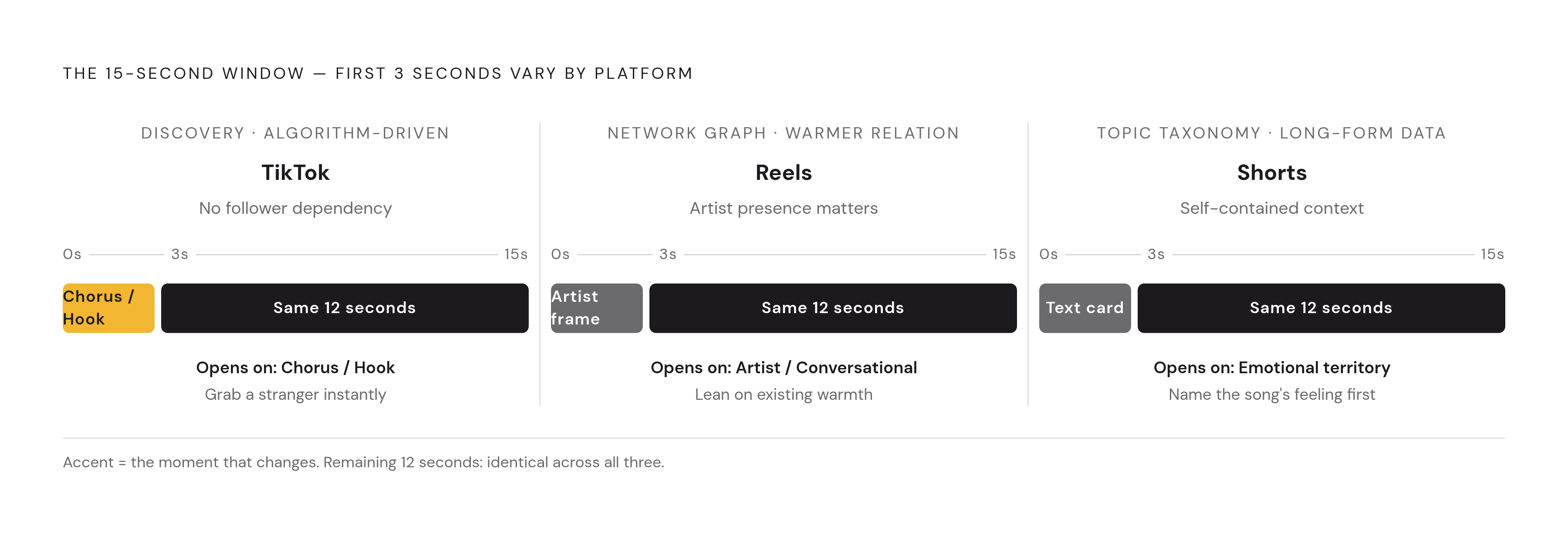
The opening three seconds put the format decision to its first test. On TikTok, the strongest entry is sound-first and emotionally immediate, using the hook or the most charged lyric without preamble. The viewer does not need a formal introduction. The clip needs to present the reason to stay before asking for interest in the artist.
Reels can begin from a more personal position. The artist’s presence, a visual setup, or conversational framing can establish a warmer register before the lyric lands. That is not permission for an unrelated introduction. The setup still needs to lead into the selected musical moment, but it can earn attention through the relationship. The opening belongs to the artist as well as the song.
Shorts needs an early signal of what the clip concerns. A visual or textual cue gives its topic-based distribution a clearer frame and helps a viewer arriving without prior context. The same 15-second lyric window can therefore begin on the chorus for TikTok, on the artist for Reels, and on a text card naming the song’s emotional territory for Shorts. The variation is concentrated where the audience decides whether to enter.
Testing snippets before committing to a full format
Before the official release, a short section can reveal where retention and comments spike, allowing release content to form around the strongest moment. The test comes before the full build. Instead of committing to a polished treatment of the entire song, the artist learns which passage deserves that investment. The audience helps choose the hook, while the artist still shapes how to present it.
Viewers may quote the lyric, ask when the song drops, or ask where they can save it. Other users may begin using the sound without prompting. When the same short window repeatedly outperforms other clips, that pattern gives the format decision a firmer basis. The evidence concerns a particular moment and response.
Production should begin with several lyric snippets of the strongest line before moving to one polished lyric video of the whole song. Different versions give the test something to compare. They also expose a mismatch between lyric and treatment before it becomes an expensive asset. A brat-style single-word sequence cannot rescue a line that does not land as text. Testing that line first keeps polish from concealing the decision that still needs to be made.
Running multiple accounts so each format finds its audience without cannibalizing the main page
Format variation also has consequences for account structure. A single profile does not have to host every treatment of a song, particularly when experimental formats differ from the artist identity established on the main page. Dedicated music accounts give TikTok a focused signal about the audience to serve. Mixed personal accounts send less clear signals about what to amplify and to whom.
Secondary accounts can provide a home for those experiments. A wall-of-text series or beat-cut series can grow without every version having to work for the main page’s audience or keep up its momentum. The main page retains the artist identity and the format series that best represent the brand. Secondary accounts are where the artist can try out formats and post sound-seeding content. The distinction is functional rather than a reason to duplicate the same feed across more profiles.
Getting other creators to use the sound extends its presence beyond the main account, while secondary-account usage can make it appear to circulate organically and prompt algorithmic expansion. Warner Records’ Senior VP/Head of Viral Marketing, Will Morrow, cited campaigns for Benson Boone, Teddy Swims, and Sombr as effective uses of the creator-use strategy. The sound and the artist page perform separate jobs. One establishes presence in the algorithm, while the other gives arriving viewers a reason to follow.
The recommended warmup is to spend the first stretch on the strongest track before introducing additional songs. That focus establishes momentum around a recognizable musical offering. Once the account has a defined role, format experiments can serve that role.
Consistency as the mechanism that turns format variation into compound growth
A format system needs a cadence to accumulate results. Without consistent volume, even well-matched clips have limited opportunities to build the momentum that turns views into listeners. Choosing formats ahead of time makes it easier to record several videos in one session, then post one per day. The creative decisions are already in place. The session produces variations within those decisions.
That cadence increases the chances of growth. More consistent output creates more opportunities for breakout clips, which can compound into monthly listener growth over time. Testing helps the artist make the most of those chances by building later clips around moments that already get a response.
Daily posting becomes the output of a system. That system can hold the song constant while varying the reading experience, the opening, and the relationship with the viewer. Consistency belongs to the process. The catalog contains versions built to earn attention in their own setting.